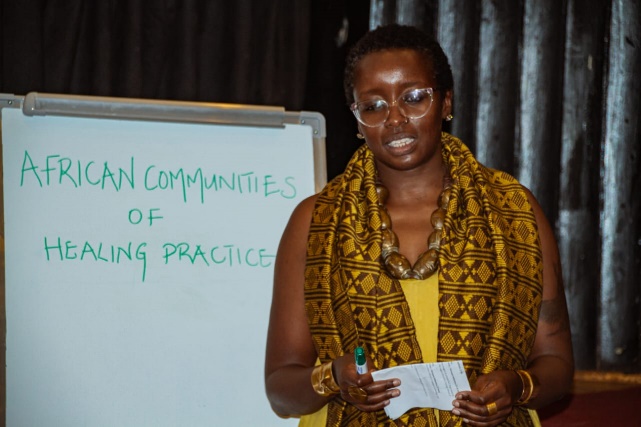
African Communities of Healing Praxis (ACoHP)
ACoHP is Enćani's flagship programme: a rotating series of collective sessions that bring together healers, activists, and communities to practise healing as a political act. Each session centres a different African healing modality: poetry, herbs, yoga, dance, food, and ceremony.
September 2025
African Communities of Healing Praxis (ACoHP) is built on a simple but radical idea: that healing is not a private matter, and it is not a product. It is a collective practice rooted in African epistemologies, and it is inseparable from the work of liberation.
Each ACoHP session gathers social justice activists, organisers, healers, and community members in a different location — at a National Theatre, in a public park, at the foot of the Rift Valley escarpment — and centres a different African healing modality. We have practised poetry as compassionate inquiry, explored indigenous herbs on an ecological walk, and moved our bodies through Afrikan Yoga at Uhuru Park.
How the Sessions Work
The rotation principle is fundamental to our pedagogy. Today's expert is tomorrow's student. Dorphan, the griot, was a teacher in the poetry session and a student in the herbs session. Kaingi, the herbalist, will be a learner in the dance session. This reflects our belief that every activist carries both knowledge and curiosity — and that learning is most powerful when it moves horizontally.
Sessions are documented in full — session reports, photographs, and reflections — and added to our Living Archive. What we do and what we learn belongs to the collective and to the future.
The Communities We Gather
ACoHP sessions draw participants from across Nairobi's movement ecosystem: social justice centres in Mathare, Kayole, Mukuru, and Kibra; liberation libraries; revolutionary organisations; feminist collectives; ecological justice movements; and Rastafari communities. We have gathered twenty-nine comrades in a single session, representing eighteen organisations.
Collective Agreements
Each cohort develops its own collective agreements — around food (alkaline and indigenous meals), time, care, and confidentiality. These agreements build discipline, accountability, and continuity. They are not rules but commitments to each other.